Monday, October 27, 2008

Economic Gangsters Uncovered!

Raymond Fisman and Edward Miguel, Economic Gangsters: Corruption, Violence and the Poverty of Nations . Princeton University Press, 2008.

This is a book that deserves a wide readership – I recommend it wholeheartedly.


Some readers will come for the clever title and the cover’s provocative silhouette of a machine-gun wielding gangster. More, I hope, will be drawn to the book by reviews like this one and the authors’ important message. Economic Gangsters is topical and lively, as its cover suggests, but it is also deadly serious and deeply engrossing.


Fisman (Columbia Business School) and Miguel (UC/Berkeley) study perhaps the most important question of our day – why some countries grow and prosper while others are trapped in a self-reinforcing cycles of violence, corruption and poverty. Economic incentives help create an these problems, the authors argue, and policies that alter economic incentives can help eliminate them.


The book features the sort of clear thinking, crisp economic analysis and creative empirical detective work that fans of Freakonomics will recognize and appreciate. Six major case studies and many smaller examples provide evidence to support the case. The authors conclude with a discussion of how cleverly designed program evaluation techniques can help uncover policies to escape the violence-corruption poverty trap.


I liked Freadonomics but I complained in my review that it didn't really have a point. Creative economic analysis is fun, but so what? What good is it? Economic Gangsters answers this critique. Economics is fun and useful. Dismal science? Hah!


One word review: Bravo!

Saturday, July 26, 2008

Globalization and Chinese Food

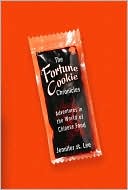
Jennifer 8. Lee, The Fortune Cookie Chronicle: Adventures in the World of Chinese Food. Twelve publishers, 2008.

I am drawn to books that explore the big issues of globalization through study of the structures of everyday life, so how could I resist this book? Jennifer 8. Lee is a metro reporter for the New York Times with a degree in economics from Harvard and a pretty active imagination. Her Chinese immigrant parents gave her the middle name 8 (eight) because that number is associated with prosperity in China. Her book tells a number of stories that are as interesting and improbable as, well, as her own story seems to be and that are not always associated with prosperity. Globalization is like that and so, apparently, is the Chinese food business.

Some of the stories are just interesting on their own. Who invented the Chinese takeout menu? How did the fortune cookie, apparently invented by Japanese bakers in California, end up as the nearly universal Chinese restaurant treat (and the source of a suspicious lottery numbers)? What is the best Chinese restaurant in the world – an audacious question that could not be answered empirically in a thousand lifetimes? (But, interestingly, I have actually eaten at Lee’s chosen winner and I can’t really disagree with her verdict.)

Lee travels to China to try to find the origin of General Tso’s chicken, a concoction that no chef in China would willingly produce. And, in the Great Kosher Duck Scandal, she examines the intersection of two sub-cultures, Jews and Chinese. The history of Chop Suey, “the biggest culinary joke played by one culture by another,” provides an opportunity for Lee to examine the history of Chinese immigrants (and anti-Chinese attitudes) in America. Good stuff.

For me, however, the most memorable story is about the Chinese restaurant economy here in the U.S., a sophisticated communication and transportation network that connects Chinese restaurants and immigrant workers across the country and the active market that results in the restaurants themselves. Here is a whole world that most of us would never know about but for this interesting book.

Read this book and you'll never look at a Chinese restaurant, menu or dish the same way again.

Wednesday, May 28, 2008

Economics for a Crowded Planet

Jeffrey D. Sachs, Common Wealth: Economics for a Crowded Planet. Penguin Press, 2008.

Jeffrey Sachs' 2005 book, The End of Poverty: Economic Possibilities for our Time, was a bold attempt to convince the world that the Millennium Development Goals could be achieved in our lifetimes. Very ambitious, I wrote in my review. Well this book takes ambition to the next level.

The goals of this new initiative are worthy of an author with the title Director of the Earth Institute (at Columbia University). Sachs challenges us collectively to embrace the goals of economic development (and poverty elimination), environmental sustainability (with adequate water provision for all) and population control. The idea is that these three sets of goals are interrelated and that you cannot really achieve any one of them unless you address all three.

The book is very interesting but I admit that I like the last chapter ("The Power of One") best because it is, well, inspiring. Sachs concludes the book by making the case for taking up the challenge of development, environment and population even though the problems seem impossibly large. He quotes one of my favorite scholars, Albert O. Hirschman to the effect that all new ideas, good and bad, are generally met with three criticisms: futility, perversity and jeopardy. The problem can't be solved (futility), if you try you might make it worse (perversity) and wasting your effort here diverts attention from other areas where progress might be made (jeopardy).

Sachs cites a number of examples of problems where substantial progress has in fact been made despite the inevitable reaction that Hirschman cited. For better or worse this last chapter really does give you a feeling that something can be done, even if we might disagree about what that something is. Probably should be required reading for Peace Corps Volunteers.

Monday, May 26, 2008

The Battle for the 21st Century

Robert J. Shapiro, Futurecast: How superpowers, populations and globalization will change the way you live and work. St. Matrin's Press, 2008.

Lester Thurow's best-selling book -- Head to Head: the coming economic battle among Japan, Europe and America -- hit the bookstores with a splash 15 years ago. Everyone wanted to know what would happen in the emerging post-Soviet world and the economist and MIT dean was ready to tell them.

Thurow forecast a world where a triad of nations would battle to write "the rules for the 21st Century." The winner would be Europe, Thurow concluded after ticking off all the usual suspects (Russia? No. China? No. America? No. Japan? Not a chance.)

Was Thurow correct? Well he was right about Japan, I guess, but was he right about the U.S. and China? Too soon to tell, I think, given that the 21st Century is still in its first decade and a lot has changed since the early 1990s. Perhaps it is time to revisit the question.

Robert J. Shapiro takes up this challenge in Futurecast. He builds his analysis around three strong forces that will shape domestic and international relations: demography (aging populations), globalization (rising competition, shifting production and consumption patterns, increasing interdependence) and the collapse of the old Soviet empire and the rise of a new geopolitical order. What countries can best adapt to this new environment, Shapiro asks? China and the U.S., he answers, but for different reasons. The critical relationship of the future is therefore the Sino-American one.

Europe and Japan will be increasingly marginalized from a geopolitical perspective in part because they will have trouble dealing with the dual challenges of demography and globalization. Other big potential players are also considered (India? Russia?) but they have problems of their own. Ireland and Korea present models of how countries can successfully develop as niche players in the global markets.

I liked Thurow's book in the 1990s because it raised a lot of interesting questions and taught me and my students a good deal about economic problems and social change around the world. I like this book for the same reason. I like it even more, in fact, because of the detailed analysis that I find here -- he goes well beyond the usual stylized facts.

That's not to say that Shapiro is necessarily right. Economic consultants are often cautioned not to make predictions that can be proven wrong before you can get to the airport. Shapiro has violated this rule by making big time forecasts in indelible ink. He might wish that he could revise what he writes here about inflation, growth and interest rates in light of the current oil crisis, food crisis and mortgage financial crisis.

Close reading, however, shows that he hedged his optimism about globalization pretty carefully and doesn't need to grab the next cab to the airport just yet. It will be interesting to see how a thoughtful and optimistic book like this is received in this presidential election year. (Note: Shapiro has been an economic advisor to Bill Clinton, Al Gore and John Kerry.)

A Splendid Exchange

William J. Bernstein, A Splendid Exchange: How Trade Shaped the World. Atlantic Monthly Press, 2008.

I thought Findlay and O'Rourke were ambitious for writing a history of international trade over the last 1000 years (see below), but William J. Bernstein goes them one better: a history of trade from Sumer (3000 BC) to Seattle (the 1999 WTO protests). The books couldn't be more different in style and yet they have many important similarities.

First, however, a disclaimer. I am predisposed to like William Bernstein's books. His daughter was a student of mine a few years ago and I was introduced to his work through her. Bernstein holds a Ph.D. in Chemistry and an M.D. in neurology and he treats everything he studies as like brain surgery -- his research is thorough and critical and his insights are often stunning. These days he writes about finance and economic history. You can read about his work at his website, efficientfrontier.com.

Bernstein knows how to tell a story, which makes this book very readable, and he has chosen his stories very well to capture the many forces, political, economic, intellectual and technological, that drove trade forward, held it back throughout its violent history. Violent? Yes, one thing that Bernstein's book shares with Findlay and O'Rourke is the strong sense that trade relations were often associated with violence and deadly force. Wealth and power are potent motivations and many lives have been sacrificed to achieve them. This will come as news to students brought up on Thomas Friedman and his theory of trade as an element of the Golden Arches theory of conflict prevention.

I found almost every part of this book utterly fascinating. Students in my International Economics and IPE Theory classes should read this book if only for Chapter 13 "Collapse," which tells the story of trade in the 20th century through the theories of Wolfgang Stopler, Paul Samuelson and Ronald Rogowski.

The books ends appropriately with analysis of the current trade debate. Bernstein notes that trade is inevitably disruptive, with losers as well as winners, in rich countries as well as poor ones. Economists may take comfort in the fact trade is positive sum -- the winners gain more than the losers lose -- but that is cold comfort for those who bear the burden. Government policies that promote increased trade but decreased social spending are doubly dangerous, therefore, since the losers may lash out against trade if their social safety net fails. It is not necessarily an accident that many of the most open economies have the strongest nets to catch those who fall.

A good lesson to keep in mind as the 2008 presidential campaign moves to the next level.

Monday, January 14, 2008

Power and Plenty: A Long View of International Trade

Ronald Findlay & Kevin H. O'Rourke, Power and Plenty: Trade, War and the World Economy in the Second Millennium. Princeton University Press, 2007.

I like books that make me reconsider what I think I know. Since I spend a good deal of my time thinking and teaching about international trade and finance, books that make me stop and think about these topics are especially valuable. Douglas A. Irwin's fascinating study of the intellectual history of the theory of comparative advantage is an example of the kind of book I mean. (Irwin, Against the Tide: An Intellectual History of Free Trade, Princeton University Press, 1996). I used this book as a supplement to a course on trade theory that I taught in Bologna a few years ago and one of my best students nearly failed her oral exam because, having studied Irwin, she had a different view of comparative advantage than her faculty examiner (who, to be fair, was probably looking for simple answers so that he could pass everyone). Irwin had made her, like me, rethink what she knew about international trade theory.

Findlay and O'Rourke's Power and Plenty is challenging me to rethink international trade in a different way. The book is very ambitious: a global history of 1000 years of international trade, explicitly taking into account economics, politics and technological change. There are probably two ways to write a book like this: simplistically, using metaphors and big themes, or rigorously, with lots of detail and data. P&P is rigorous -- a book to study rather than browse. But even browsing can pay dividends.

Most studies of international trade are relatively narrow both in terms of the actors (one nation's trade policy or regional trade patterns) and time period (the 1990s, the postwar period, etc.). The thesis of this book is that there is something to be learned be looking at global trade patterns and by taking a long view of history. The risk, of course, is that you can get so involved with the details that you miss the importance of the big picture, but it is a risk worth taking and Findlay and O'Rourke are effective guides.

Here are two examples. I thought I knew quite a bit about the mercantilist period of trade history, but I find that taking the global view -- which means giving greater attention to the slave trade with Africa -- changes the picture in important ways. And taking the long view of trade history helps me understand what is happening today more fully. P&P characterizes trade during the Industrial Revolution as The Great Specialization, with manufacturing concentrated in the global North and trade patterns developing based upon a global division of labor. The current era of globalization is therefore a period of "unraveling" of the great specialization, with manufacturing being diffused globally bringing about dramatic changes both in Malaysia (a new center of manufacturing) and Michigan (an old center), for example.

Sunday, December 23, 2007

Redefining Global Strategy (or would you rather be a Jackalope?)

Pankaj Ghemawat, Redefining Global Strategy: Crossing Borders in a World Where Differences Still Matter. Harvard Business School Press, 2007.

Thomas Friedman has famously argued that the world is flat -- that globalization has reduced many of the barriers to competition that once existed between and among countries. You've got to study hard -- invest in education, infrastructure and knowledge -- if you want to succeed in the flat world. Otherwise some smart guy from Bangalore is going to take your job! There's little to prevent this in the flat world of globalization today.

I suppose you can think of Pankaj Ghemawat as that smart guy from Bangalore, although he's really from the Harvard Business School and IESE Business School in Barcelona. He's studied globalization good and hard and ... guess what? ... it turns out the world isn't flat after all. Globalization isn't complete -- it is "semiglobalization" at best -- and businesses (and by extension, I suppose, nations, although he doesn't really talk about this) need to take into account the differences if they want to succeed.

The book is written in Business-schoolese, with diagrams, acronyms and lots of exclamation points (although, to be fair, it is far from the worst offender in this regard). Ghemawat uses the acronym CAGE to denote the differences among countries: Cultural, Administrative, Geographic and Economic. He does a nice job using this framework to show why India's trade with the United States has evolved along different lines from the China trade. India has Cultural advantages (more English speakers) and Geographic disadvantages (Indian ports are much farther away from the U.S. and are logistical nightmares compared to more efficient Chinese ports). This helps explain why China exports more products (where language is less important and ports are critical) while India exports more services, where language is key and electronic delivery sidesteps transportation bottlenecks. The full analysis is much more complex than this, of course, but you probably get the idea.

The CAGE differences also create regional CAGE similarities. One of the defining characteristics if semiglobalization is regionalization and it can take many forms. We are used to thinking of regionalization is Geographic terms, but there are also Cultural regions (the English speaking world, for example, or the Indian and Chinese diasporas) as well as Administrative regions (collections of countries with common legal systems and government structures due, for example, to common colonial influences) and of course common Economic regions (the
US-EU-Japan triad countries with their high incomes and large markets).

How does a business deal with CAGE differences and similarities? With AAA strategies, of course! AAA stands for Adaptation, Aggregation and Arbitrage. Some companies learn to adapt to the differences in order to succeed. Adapting can be costly, but it is often cheaper than the mistakes you make when you don't apart. Others choose their markets carefully so that they fall into one of the CAGE regions. Then they can Aggregate based upon commonalities and profit from economies of scale. Finally, businesses can Arbitrage the differences among countries, especially in production though variations on outsourcing. Luxury goods companies, which are some of the most successful global businesses, often arbitrage cultural differences, for example.

The most successful businesses will find ways to profit from two of the three As, Ghemawat suggests but he cautions against trying to employ all three strategies, comparing the resulting business a Jackalope (see drawing at right). I wonder if there are enough internal trade-offs among strategies that they form a trilemma -- pick two and the third is impossible? Ghemawat doesn't suggest a trilemma, but he is sure skeptical about the potential of a AAA play.

This is a very interesting book that deserves the attention it has received recently -- and not just because it disagrees with Thomas Friedman. When I started reading it I was fascinated by the brief case studies that Ghemawat uses to illustrate his framework, but annoyed with the framework itself with its acronyms and B-school jargon. I liked the stories but I wasn't that keen on the lectures that they came wrapped in. But, to my surprise, the frameworks became more and more useful as the complexity of the problems increased. Now I cannot wait to try to apply Ghemawat's analysis to the global wine market and so to write a new story myself.

My advice: stick with this book and you will be rewarded. Otherwise you could end up with a strategy that is as well designed as a jackalope.