Saturday, March 21, 2009

Animal Spirits

George A. Akerlof and Robert J Shiller, Animal Spirits: How Human Psychology Drives the Economy and Why it Matters to Global Capitalism. Princeton University Press, 2009.

Freakonomics redefined the popular economics book genre. This runaway best-seller created a niche for an economics book that could speak seriously to the masses (the serious mass, if that isn't some sort of oxymoron) and get them to rethink both economics (particularly microeconomics) and their view of the world. It was a great if uneven read, I said in my review, but kinda pointless. I thought the authors missed a good opportunity to criticize policymakers and pundits for their uncritical acceptance of conventional wisdom and the harm this has caused. Instead they just let the many and varied examples and case studies speak for themselves. Too bad.

Animal Spirits is a sort of macroeconomic Freakonomics but with one difference. It has a point. Many points, in fact. More about this later.

Ackerlof and Schiller are as distinguised as you can get in economics. Ackerloff won the 2001 Nobel Prize in Economics for his work on how economies actually work in the messy, inconvenient real world (think "The Market for Lemons"). Schiller is famous for Irrational Exuberance and his studies of unstable financial markets. Smart guys.

Animal Spirits is a book about how individual feelings and attitudes, which are not always strictly rational, matter in macroeconomics and how ignoring them has helped put us in the current financial and economic hole. Most people associate the term "animal spirits" with Keynes (animal spirits, he said, are what drive the stock markets) and sure enough Keynes and his ideas make frequent appearance here.

The organization of the book is clear enough. The authors begin with short chapters about five flavors of animal spirits -- confidence, fairness, dishonesty, money illusion and the particular power of stories to shape human attitudes and behavior) and then apply these concepts to eight questions, including why do economies fall into depression, how can the current financial crisis be solved and why are there booms and busts in real estate markets? As you can see, this is a book that asks a lot of big questions and promises a lot of big answers.

There are several problems, not least of which is that it is difficult to answer all these questions in a slim volume like this one and especially hard to make all of the answers depend critically and specifically on animal spirits (although this main point is well argued, especially concerning the importance of fairness in economic decisions). Animal Spirits makes lots of points along the way -- maybe too many of them? -- and in doing so seems to sometimes lose track of its audience.

Who is this book for? Is it for professional economists who will be interested in rethinking longstanding intellectual debates within the profession? Is it for investors who need to understand how markets really work? Is it for ordinary citizens who just want a better idea of how we got into this mess and where we can go from here? The answer is that the authors seem to address many different potential audiences and therefore risk losing some or all of them. A pity.

If you can judge a book by its cover (I know, I know) then this book is for New Yorker readers -- serious readers who will recognize the distinctive Edward Koren cartoons that decorate the wrapper. I suppose that's as good a target audience as any.

Is this the macroeconomic Freakonomics? No, but it's a good book for befuddled economics-literate people like me. And maybe you, too.

Friday, January 2, 2009

Krugman on the Crash of 2008

Paul Krugman, The Return of Depression Economics and the Crash of 2008. Norton, 1999, 2009.

This book is a very substantial revision of a 1999 volume called The Return of Depressions Economics. The title was meant to shock in 1999. Financial crises like Thailand's or deep persistent slumps like Japan's -- they couldn't happen here, could they? Krugman wanted to wake up policy makers to the fragility of the financial system and the idea that financial crisis could lead to depression-style economic crisis. No one will be shocked by the title today, ten years later.

I have used this book in my classes continuously since it was first published, although my spin on it has evolved as economic conditions have changed. Krugman's revision is pretty much in line with the way I taught this material last semester. I take this to mean that I have not entirely misread the world has we have moved towards this point, although I obviously do not claim Krugman's expertise. Or maybe we both misread it the same way. Time will tell.

Not everyone will be happy with the way the book is organized. Krugman saves his analysis of the current crisis until the final chapters and I think many readers will want to see this material earlier. But I am on Krugman's side. It seems to me that you really do need to understand the financial crises of the last twenty years in order to appreciate our current situation. Those who don't understand history are doomed to repeat it, they say. The crises in Japan, Mexico, Thailand, Hong Kong, Russia and Argentina give Krugman an opportunity to introduce key theories and concepts in a real world context that is highly relevant to the final analysis.

Not everyone will like the end of the book, either, where Krugman provides policy recommendation. Many readers will be looking for very detailed proposals from the most recent Nobel winner instead of broad outlines, but is that fair to ask? Events move too quickly now; the situation is so fluid. Krugman's three-part plan (large-scale capital infusions to stop the financial crisis, large-scale fiscal stimulus to end the economic slump, reformed financial regulation to extend bank-type controls to bank-like institutions) makes sense now and will probably be seen to make sense when we look back upon them in ten years.

One thing that I missed was a fuller discussion of capital controls. Krugman talked in more detail about controls on destabilizing hot money movements in the earlier volume and comes very close to endorsing them here, at least in emergency situations. But he doesn't really make the case. You can't please everyone, I guess.

There are many good moments in the book, including the analysis of the Greenspan years and the housing bubble and the discussion of hedge funds and the rise of unregulated non-bank banks. And there was one scary moment for me. Reading the first paragraph of the last chapter I immediately recognized the words. Where had I read them before? "The world economy is not in depression; it probably won't fall into depression ..." (my emphasis added).

Oh, yes. They are exactly the same words he in this same place in the book used ten years ago.

Empires of Trust

Thomas F. Madden, Empires of Trust: How Rome Built -- and America is Building -- a New World. Dutton, 2008.

It has been all the rage to talk about the world -- and especially the United States -- in terms of empires in recent years. It began, I think, with the collapse of communism, leaving the U.S. as the sole superpower and it accelerated after 9-11 as U.S. policy became more intentionally international. My colleague Dave Balaam teaches a class on Empires -- one of probably hundreds offered on college campuses today. He doesn't have to look very far to find interesting books and articles for his students to read.

Part of the appeal of Empires today is the idea of rise and fall and these are times when it looks to many like the U.S. is heading for collapse; thinking about the U.S. this way fits easily into the arguments the pessimists want to make.

Thomas F. Madden's book takes the idea of a U.S. empire seriously -- as a real condition rather than a loose metaphor -- and his book makes good reading whether you are into the empire idea or not. Empires rise and fall, Madden says -- that's what they do. But they aren't all the same. He cites three types of empires: empires of conquest (not given much treatment here), empires of commerce (like Britain in the 19th century) and empires of trust (Rome ... and the United States).

Empires of conquest and commerce are intentionally outward-looking. They seek resources and markets respectively. But empires of trust, in Madden's analysis, just want want to be left alone. They mainly venture abroad when foreign actions are necessary for domestic (should I say "homeland") security. Empires of trust have different motives and actions, Madden argues, and have the potential for long life. Rome's empire lasted for centuries before the inevitable collapse. There is no particuar reason to think that the U.S. era will be over soon if the U.S. holds true to the principles that cause foreign powers to trust its motives.

Madden's method here is to tell stories of Rome's experiences in some detail and then use them to reflect on key events in U.S. international policy. Some of the insights have astonishing, causing me to stop and rethink previous opinions. That's the purpose of the book, in my view. Not to convince you that the U.S. empire is a good thing (although it might be) or that it is fundamentally peace-seeking (because it isn't always), but rather to get you to think seriously about world affairs and not fall into shallow intellectual ruts, as it is so easy to do.

So I recommend this book very highly (and I thank my mentor Phil Phibbs for recommending it to me) as an aid to serious analysis. You need to read the whole book, however, to capture the full effect. This is not a burden, however, as Madden is a good story teller. I devoured the 300 pages on the plane to Tucson.

Saturday, November 29, 2008

The Irrational Fear of Globalization

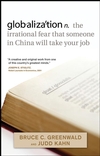
Bruce C. Greenwalk and Judd Kahn, globalization n.: the irrational fear that someone in China will take your job. John Wiley & Sons, 2009.

Fables beat tables, Greenwald and Kahn believe, and they are not very happy about it.


Fables, metaphors and anecdotes (think Thomas Friedman) have proven more persuasive than facts and figures in shaping public attitudes and policies regarding globalization. The stated aim in this book is to push back, fighting stories with solid data. No one who reads this blog will be surprised that I am sympathetic to this general line of reasoning: my 2005 book Globaloney made much the same argument.


globalization is very much a critique of the anti-globalization literature in the style of recent volumes by Jagdish Bhagwati (In Defense of Globalization) and Martin Wolf (Why Globalization Works). globalization arrives a bit late to the party, to be honest, after most of the big issues have been pretty thoroughly chewed over (a fault it shares with Bad Samaratans reviewed below). A lot of the points that the authors reveal dramatically are no longer fresh. Globalization is not a new thing? Yes, I've read that before. The Local is generally more important than the Global? Uh huh.


Books like this sometimes feel as though they were written in response to Joseph Stiglitz's Globalization and its Discontents, which first appeared back in 2002 (Greenwalk has actually taught a class on globalization with Stiglitz at Columbia). Maybe it is just me -- I've read a lot of globalization books -- but it takes something really new and original to grab my attention.


globalization’s strength lies in its clear application of basic economic principles to reveal the hidden logic (and illogic) of claims about globalization’s causes and effects. It is the analysis that actually impressed me more than the data.


This book actually appears at an opportune moment. The current economic crisis is likely to cause globalization to recede -- businesses and governments will pull back from global strategies and embrace local and regional arrangements. This book, if read in the right way, shows why this makes sense now -- and in fact has made sense all along. The chapters on financial markets and institutions, while not written with today's financial crisis in mind, are still useful in making sense of the changed environment.


The book would be a more useful tool for students if it included a bibliography (why do serious books leave this out?) and if more detailed notes were provided. And it would make a greater contribution to the literature if it gave a better answer to the question, why do fables beat facts?

Thursday, October 30, 2008

The Myth of Free Trade

Ha-Joon Chang, Bad Samaritans: The Myth of Free Trade adn the Secret History of Capitalism. Bloomsbury Press, 2008.

Ha-Joon Chang (Faculty of Economics, University of Cambridge) has written a witty and interesting reply to go-go globalization books. Anyone who believes the myth that today’s wealthy nations got that way through neoliberal free trade policies (and that this is the only road for developing countries today) will be entertained and informed by the “secret history” of protectionism.

The book is provoked by Thomas Friedman (The Lexus and the Olive Tree), informed by Friedrich List and driven by a deep understanding of the real history of economic development in Asia and elsewhere. I found the chapter on corruption especially good, although there is much to appreciate throughout.

The book is aimed at a general audience and the writing sometimes understandably lapses into the sort of rhetorical excess that Friedman et. al. are known for and therefore comes dangerous close to the sort of rhetoric I wrote about in Globaloney. Sometimes, alas, I think the author even crosses the line.

I wish that there had not been quite such a long gestation period between the debates that provoked the book and its eventual appearance. Finally, a bibliography would have made this volume more useful to potential student readers.

Interested readers should also check out Dani Rodrik One Economics, Many Recipes for a well-reasoned recent critique of free trade orthodoxy.

Economists Speak Out!

Joseph Stiglitz, Aaron Edlin and Brad Delong (editors), The Economists' Voice: Top Economists Take on Today's Issues. Columbia University Press, 2008.

The Economists’ Voice
(http://www.bepress.com/ev/) is an innovative online journal (part of the Berkeley Electronic Press project) where prominent economists discuss and debate important public policy issues. The articles collected in this volume were originally published online and are still available there, an advantage especially to students who seem increasingly to rely upon online rather than hardcopy resources.

The book contains 35 short essays in nine broad theme areas. Climate change is analyzed by a trio of Nobel Prize winners, Thomas Schelling, Kenneth Arrow and Joseph Stiglitz. Other themes (and selected authors) include the International Economy (Bradford DeLong), the economics of the Iraq war (Stiglitz), U.S. fiscal policy (Michael Boskin and Ronald McKinnon), social security (Paul Krugman, Edward Lazear and Barbara Bergman), and tax reform (Boskin, Martin Feldstein, Robert Frank). Social policy, the death penalty and real estate markets complete the eclectic mix of topics.

I recommend this book, but I books are inevitably dated, so I recommend readers check out the online journal with its full archive and continuing stream of thoughtful articles on important policy issues.

Monday, October 27, 2008

Economic Gangsters Uncovered!

Raymond Fisman and Edward Miguel, Economic Gangsters: Corruption, Violence and the Poverty of Nations . Princeton University Press, 2008.

This is a book that deserves a wide readership – I recommend it wholeheartedly.


Some readers will come for the clever title and the cover’s provocative silhouette of a machine-gun wielding gangster. More, I hope, will be drawn to the book by reviews like this one and the authors’ important message. Economic Gangsters is topical and lively, as its cover suggests, but it is also deadly serious and deeply engrossing.


Fisman (Columbia Business School) and Miguel (UC/Berkeley) study perhaps the most important question of our day – why some countries grow and prosper while others are trapped in a self-reinforcing cycles of violence, corruption and poverty. Economic incentives help create an these problems, the authors argue, and policies that alter economic incentives can help eliminate them.


The book features the sort of clear thinking, crisp economic analysis and creative empirical detective work that fans of Freakonomics will recognize and appreciate. Six major case studies and many smaller examples provide evidence to support the case. The authors conclude with a discussion of how cleverly designed program evaluation techniques can help uncover policies to escape the violence-corruption poverty trap.


I liked Freadonomics but I complained in my review that it didn't really have a point. Creative economic analysis is fun, but so what? What good is it? Economic Gangsters answers this critique. Economics is fun and useful. Dismal science? Hah!


One word review: Bravo!